
Laminar: Understand why your AI agent breaks. Iterate fast to fix it.
Laminar is open-source observability for AI agents. Trace complex workflows, replay and debug agent runs, and detect anomalies across trajectories at scale.
Tracing that actually helps you understand what happened
Most observability platforms collect data and leave you to dig through trees of spans. For a simple LLM call, that works. For an agent that ran for 30 minutes and made 200 decisions, it's practically useless.
Laminar's tracing gives you as much information as quickly as possible. The trace timeline and reader mode lay out the agent's reasoning and actions as a clean, readable feed.
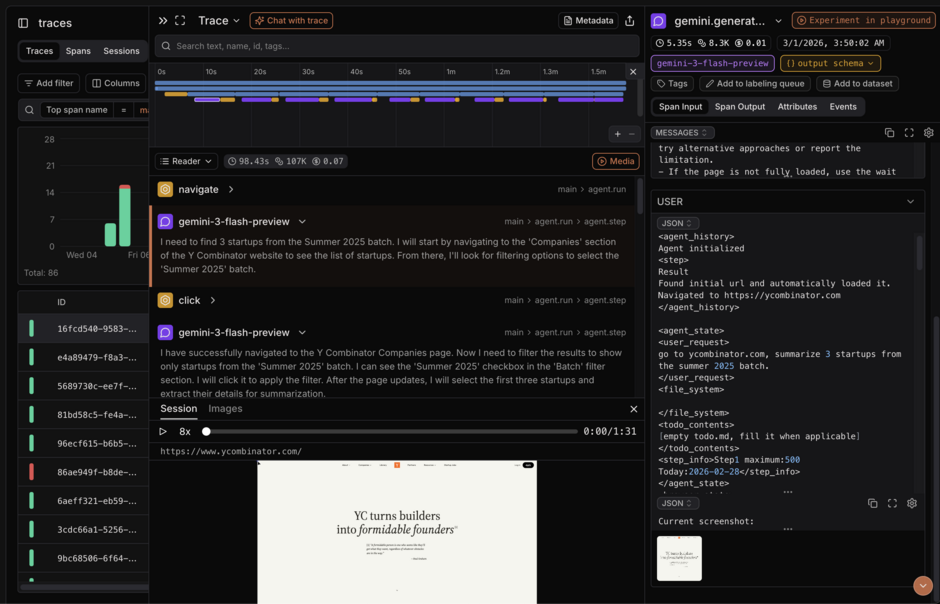
You open a trace and immediately see what the agent did, what it was thinking, and where things went wrong—including application-level exceptions. For browser agents, Laminar records full browser sessions synced with traces, so you literally see what the agent saw at every step.
If a trace is too complex to parse visually, you can chat with it: ask questions about what happened in natural language instead of manually digging through hundreds of steps. Laminar takes into account the whole context of the trace, not just a single span.
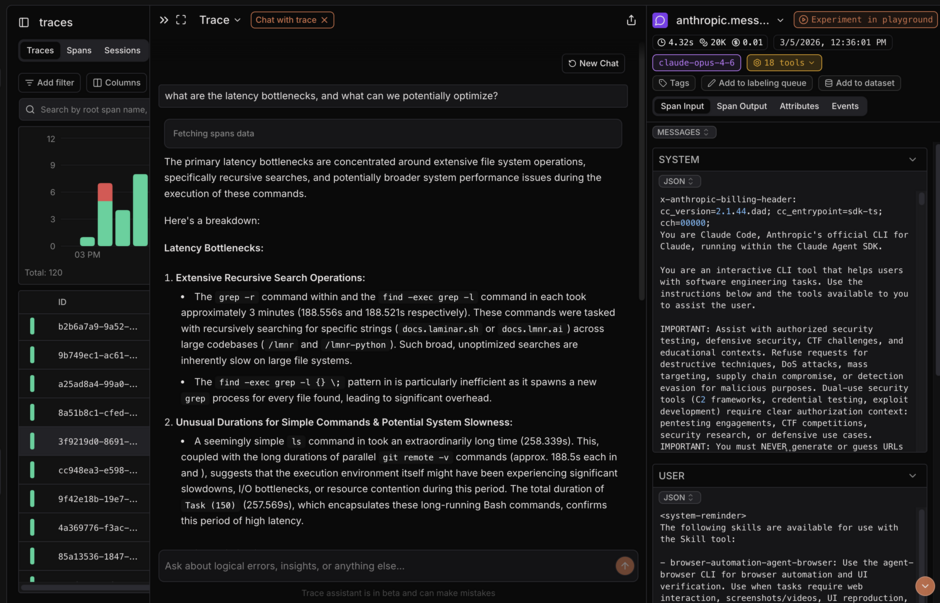
The SDK integrates with one line of code and auto-patches the vast majority of AI frameworks and SDKs, including Claude Agent SDK, AI SDK, LiteLLM, Browser Use, Stagehand, and OpenHands SDK. Laminar is the only platform that traces Claude Agent SDK sub-agents—when Claude delegates work to sub-agents, you get full visibility into that entire chain, not just the top-level call.
The debugger
When your agent fails 15 minutes into a run, the normal workflow is: restart from scratch, wait for it to reach the same state, hope it reproduces the failure. Laminar's debugger solves this.
Start a local dev server that connects to the platform. Run your agent directly from the UI, and when a run fails, go to the exact step where it went wrong. Tweak your prompt or tool definitions right in the UI and rerun from that step with full context preserved.
Here's how it works: the tracing SDK sits right before the LLM call boundary. When you rerun from a step, Laminar mocks all the LLM calls that happened before that point, replaying their original responses. The agent walks through its prior steps instantly without calling any LLMs or spending tokens—and crucially, it properly restores external state along the way. If your agent was controlling a browser, the browser gets back to the exact page and DOM state. If it was working in a sandbox, the sandbox is restored. By the time execution reaches your breakpoint, everything—conversation history, tool state, external environment—is exactly as it was. Tweak your prompt, hit rerun, and the agent picks up from there with the real world intact.
Signals
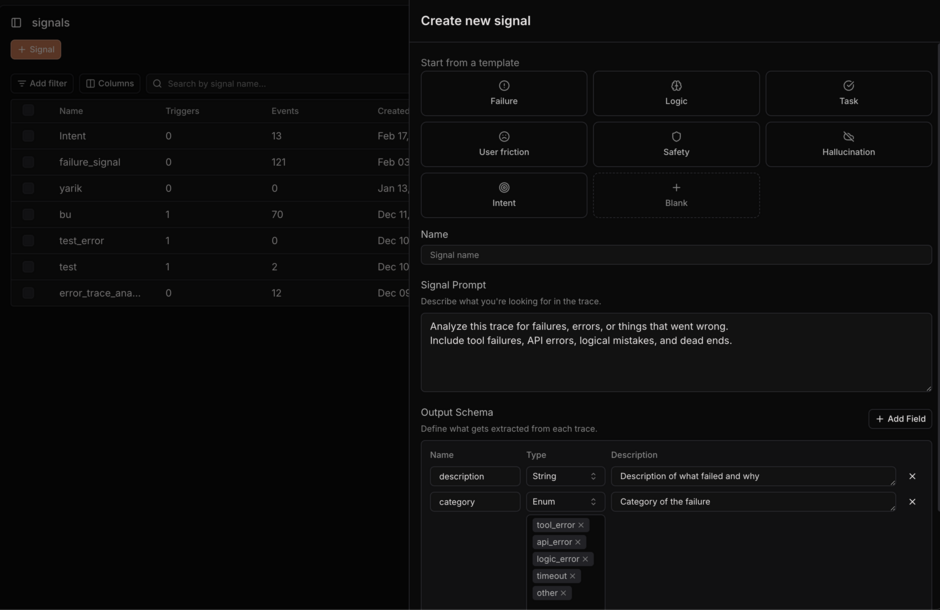
In development, you care about individual runs. In production, you have thousands of runs and the question changes—it's no longer "why did this run fail," it's "what's going wrong across all my runs and how often."
Signals detect patterns across your traces. Write a short natural language description of what you want to detect—something like "agent gets stuck in a retry loop" or "user gets frustrated and rephrases their request." Laminar runs this against every trace, extracts matching events, and clusters them into patterns. Instead of manually sampling traces hoping to spot trends, you get a structured view of what's actually happening.
SQL editor, evals, and more
All of your data is accessible with a built-in SQL editor (both in UI and API). Run arbitrary queries against your traces, spans, and events—build custom dashboards, do ad-hoc analysis, or bulk-create datasets from production traces. Those datasets plug directly into the evals pipeline, so you can run evaluations on real production data instead of synthetic test cases.
About Laminar
Leading agent companies like Browser Use, OpenHands, Rye.com, and Alai use Laminar in production. Laminar is fully open source and extremely fast (written in Rust). Self-host it anywhere or use the managed platform at laminar.sh.
For questions or partnerships, reach out to founders@lmnr.ai or star the project on GitHub.